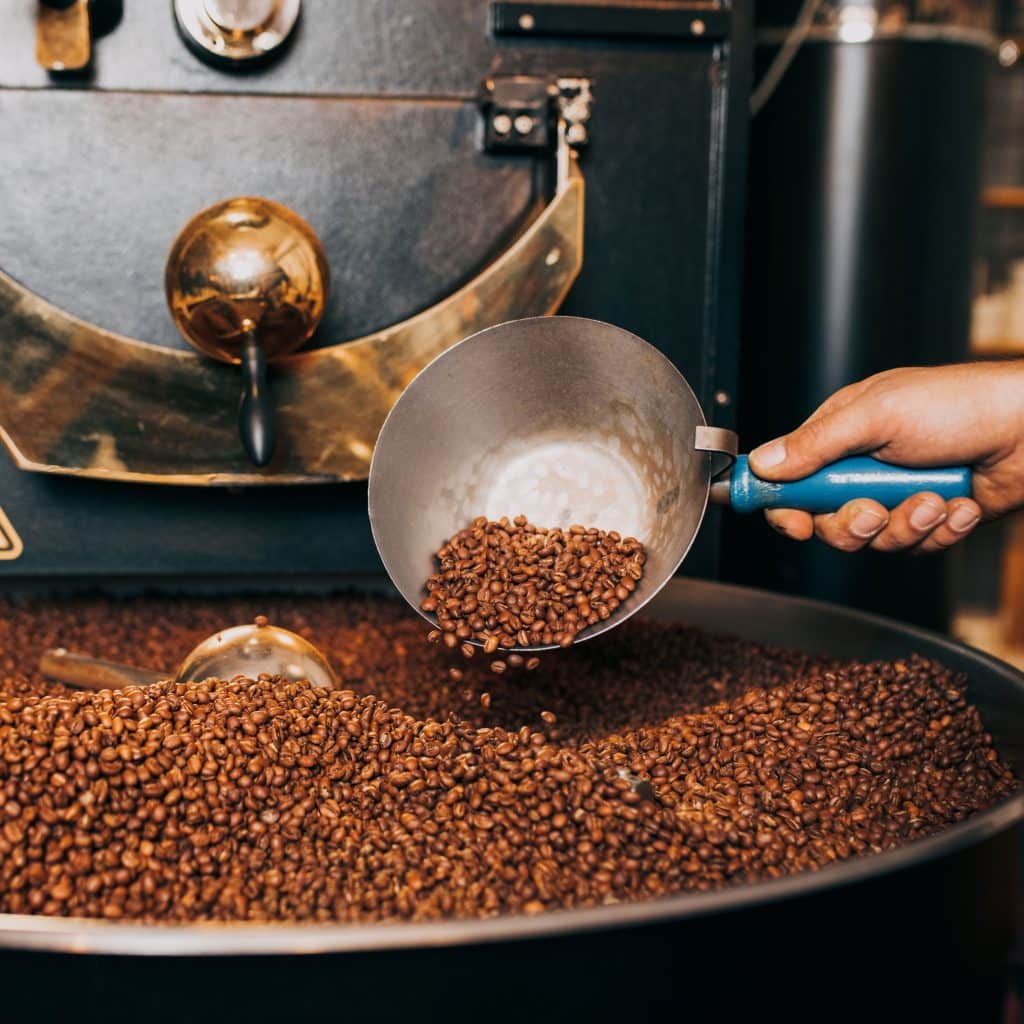
Roasting
When they are roasted, coffee beans expand to double their volume, develop their flavours (over 800), change from green to brown and lose their humidity.
It is a sudden and practically complete transformation of the product.
There are several types of roasting:
- Flash roasting (90 seconds). This method, which is used only by coffee manufacturers, develops higher acidity and less bitterness. The coffee is not very fruity and loses many flavours.
- Traditional roasting (10 to 20 minutes). This is the method used by traditional roasters. It develops bitterness, a solid aftertaste and fruity notes.
- Home roasting is today possible with the little electric roaster sold by TERRA KAHWA®.
- Traditional roasting used to be done with a metal plate or a pan placed on the stove. However, with this method, there is a risk of fire.
The characteristics of a coffee roasted with the same method can be changed when the roasting time is varied,
- A short roasting time gives an acidic coffee with the toast or cereal flavours preferred by Americans.
- When it is roasted for a longer period as is done in France, the acidic flavour is decreased while the bitterness is increased. This normally gives a more balanced coffee (as acidic as it is bitter).
- Italian-style roasting, that lasts even longer, enhances the bitterness.
- There is now a burnt caramel flavour.
Lastly, two coffees of different origins are not roasted in the same way. For example, an acidic and fruity Ethiopian Sidamo must be light roasted.
Ultimately, roasting is a matter of personal taste.
Cooling
The coffee must be cooled rapidly to stop the cooking process after roasting. Two cooling methods are used:
- Cooling with cold air (non-industrial method)
- Cooling with water (industrial method)
This method oxidises the coffee and blocks the favours.
During roasting a thin silver skin called the spermoderm is released from the beans.